Article Plan: Metric Units Chart PDF
This article details comprehensive metric units chart PDF resources, covering conversions, base units, prefixes, and practical applications like cooking and beyond.
Charts and tables for length, mass, volume, and temperature will be explored, alongside metric-to-US customary conversions for everyday use.
We’ll also guide you on finding reliable online resources and even creating your own customized metric conversion charts for specific needs.
The metric system, a universally adopted system of measurement, offers a standardized and logical approach compared to traditional systems. Understanding metric units is crucial in science, engineering, and everyday life, and a metric units chart PDF serves as an invaluable tool for quick and accurate conversions.
Historically, diverse measurement systems created confusion; the metric system, with its base-ten structure, simplifies calculations and reduces errors. This article will explore the core components of the metric system, focusing on base units like the meter, kilogram, and second, alongside commonly used prefixes such as kilo-, centi-, and milli-;
We’ll delve into practical applications, demonstrating how a readily available metric units chart PDF can streamline tasks in cooking, DIY projects, and various professional fields.
Why Use a Metric Units Chart?
A metric units chart PDF provides a readily accessible and organized reference for converting between different metric units, eliminating mental calculations and potential errors. Whether you’re following a recipe, building furniture, or working on a scientific project, quick conversions are often essential.
These charts consolidate essential conversion factors in a single document, saving time and improving accuracy. They are particularly useful when dealing with multiple conversions or unfamiliar units. Printable charts offer portability, allowing access even without an internet connection.
Furthermore, a well-designed chart simplifies understanding the relationships between units, fostering a stronger grasp of the metric system itself;
Understanding the SI Base Units
The International System of Units (SI) forms the foundation of the metric system, utilizing seven base units to define all other measurements. A metric units chart PDF often highlights these core units: meter (length), kilogram (mass), second (time), ampere (electric current), kelvin (temperature), mole (amount of substance), and candela (luminous intensity).
Understanding these base units is crucial for interpreting and utilizing metric conversions effectively. Derived units, like velocity (meters per second) or density (kilograms per cubic meter), are built upon these foundations.
Charts frequently display these base units alongside their symbols, aiding in quick identification and accurate calculations.
Meter (Length)

The meter (m) is the SI base unit for length, fundamental to any comprehensive metric units chart PDF. Originally defined based on the Earth’s circumference, it’s now defined by the distance light travels in a specific time.
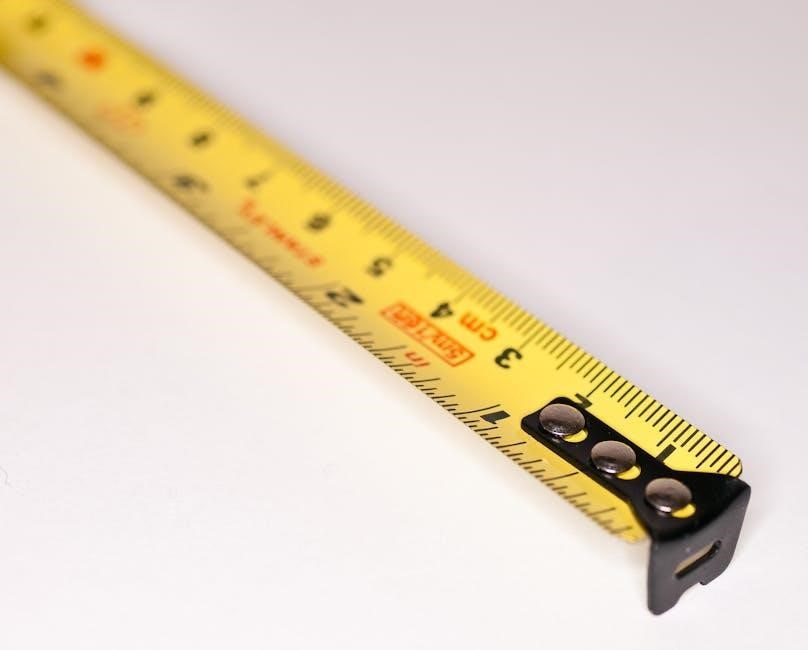
A meter is approximately 39.37 inches. Charts commonly show conversions like kilometers (km – 1000 meters), decimeters (dm – 0.1 meters), centimeters (cm – 0.01 meters), and millimeters (mm – 0.001 meters).
Understanding these multiples and submultiples is key to practical application. Visual aids within a PDF chart often demonstrate these relationships, simplifying length measurements in various contexts.
Kilogram (Mass)
The kilogram (kg) serves as the SI base unit for mass, a crucial component of any useful metric units chart PDF. Initially based on the mass of a liter of water, it’s now defined by a physical standard – the International Prototype Kilogram.
A kilogram is approximately 2.205 pounds. Conversion charts typically illustrate relationships with grams (g – 0.001 kg), milligrams (mg – 0.000001 kg), and tonnes (t – 1000 kg).
Accurate mass measurement is vital in science, industry, and daily life. A well-designed PDF chart will visually represent these conversions, aiding in quick and precise calculations for various applications.
Second (Time)
The second (s) is the SI base unit of time, a fundamental element within any comprehensive metric units chart PDF. Defined by the frequency of radiation emitted by cesium-133 atoms, it provides a highly accurate and consistent standard.
Conversion charts often display relationships with milliseconds (ms – 0.001 s), minutes (60 s), hours (3600 s), and days (86400 s). Understanding these relationships is crucial for various calculations.
Time measurement is essential in scientific experiments, athletic events, and everyday scheduling. A clear, visually organized PDF chart simplifies these conversions, promoting efficiency and accuracy in diverse contexts.

Common Metric Prefixes
A useful metric units chart PDF heavily relies on understanding common metric prefixes, which modify base units to indicate multiples or fractions. These prefixes are essential for expressing quantities concisely and efficiently.
Key prefixes include kilo- (x1000), centi- (x0.01), and milli- (x0.001), frequently appearing in length, mass, and volume conversions. Charts clearly illustrate how these prefixes alter the base unit’s value.
Mastering these prefixes streamlines calculations and interpretations. For example, 1 kilometer equals 1000 meters, and 1 centimeter is one-hundredth of a meter. A well-designed chart simplifies these relationships, enhancing usability.
Kilo- (x1000)
Within a comprehensive metric units chart PDF, the prefix “kilo-” signifies multiplication by 1000. This prefix is widely used to represent larger quantities, simplifying notation and improving readability.
For instance, 1 kilogram (kg) equals 1000 grams (g), and 1 kilometer (km) is equivalent to 1000 meters (m). Charts effectively demonstrate this scaling, providing quick reference for conversions.
Understanding kilo- is crucial for practical applications, from measuring distances to determining mass. A clear metric chart will highlight kilo- conversions, aiding in accurate calculations and reducing potential errors. It’s a foundational element for metric system fluency.
Centi- (x0.01)
A well-structured metric units chart PDF clearly defines “centi-“ as representing multiplication by 0.01, or one-hundredth. This prefix denotes smaller quantities, often used for precise measurements in various fields.
For example, 1 centimeter (cm) is equal to 0.01 meters (m), and 100 centimeters make up 1 meter. Conversion charts visually illustrate this relationship, making it easy to grasp the scale.
The centi- prefix is particularly relevant in contexts requiring accuracy, such as tailoring or scientific experiments. A detailed metric chart will showcase centi- conversions, facilitating accurate calculations and minimizing discrepancies. Mastering this prefix enhances metric system proficiency.

Milli- (x0.001)
A comprehensive metric units chart PDF highlights “milli-“ as signifying multiplication by 0.001, representing one-thousandth of a base unit. This prefix indicates very small quantities, crucial in scientific and technical applications.
For instance, 1 millimeter (mm) equals 0.001 meters (m), and 1000 millimeters constitute 1 meter. Visual metric conversion charts effectively demonstrate this proportional relationship, aiding quick comprehension.
The milli- prefix is frequently encountered in measurements like rainfall (millimeters) or medication dosages. A well-designed metric chart will provide clear milli- conversions, ensuring accurate calculations and reducing potential errors. Understanding this prefix is vital for practical metric system usage.
Metric Length Conversions Chart
A robust metric units chart PDF must include a detailed length conversion table. This chart typically begins with the base unit, the meter (m), and extends to common multiples and submultiples.
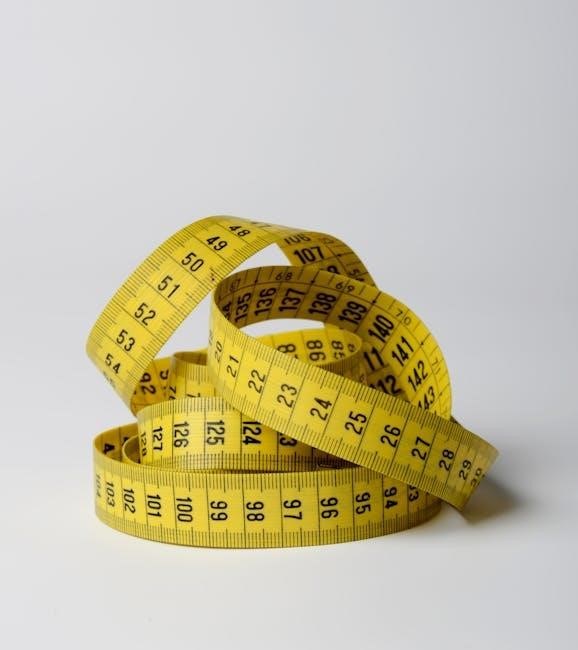
Key conversions include: 1 kilometer (km) = 1000 meters, 1 meter = 100 centimeters (cm), and 1 meter = 1000 millimeters (mm). Metric conversion charts often present this information in a clear, tabular format for easy reference.
Visual aids, like lines representing different lengths, enhance understanding. Accurate length conversions are essential in fields like engineering, construction, and everyday measurements. A quality metric chart simplifies these calculations, promoting precision and efficiency.
Metric Mass/Weight Conversions Chart
Essential to any comprehensive metric units chart PDF is a clear mass/weight conversion table. The kilogram (kg) serves as the base unit, with conversions extending to grams (g) and milligrams (mg).
Common conversions include: 1 kilogram = 1000 grams, and 1 gram = 1000 milligrams. Metric conversion charts frequently display these relationships in an organized manner, facilitating quick calculations.
Understanding the difference between mass and weight is crucial; mass is the amount of matter, while weight is the force of gravity on that mass. A well-designed metric chart will often clarify this distinction. Accurate mass conversions are vital in science, medicine, and commerce.
Metric Volume/Capacity Conversions Chart
A robust metric units chart PDF must include a detailed volume/capacity conversion section. The liter (L) is the base unit for volume, with common conversions to milliliters (mL) and cubic centimeters (cm³).
Key relationships include: 1 liter = 1000 milliliters, and 1 cm³ = 1 mL. These conversion tables are particularly useful in scientific experiments, cooking, and measuring liquids.
Charts often present conversions for larger units like cubic meters (m³) as well. Accurate volume measurement is critical in various fields, and a clear metric chart simplifies these calculations. Understanding these conversions is essential for anyone working with metric measurements.
Temperature Conversion: Celsius to Fahrenheit
A comprehensive metric units chart PDF invariably features temperature conversions, specifically Celsius (°C) to Fahrenheit (°F). While not a direct unit conversion within the metric system itself, it’s crucial for practical application, especially when interacting with US customary units.
The standard formula is: °F = (°C × 9/5) + 32. Conversion tables often provide quick references for common temperatures, like 0°C = 32°F and 100°C = 212°F.
Accurate temperature conversion is vital in cooking, weather reporting, and scientific contexts. A well-designed metric chart will clearly display this formula and offer pre-calculated values for ease of use, bridging the gap between metric and imperial systems.
Printable Metric Conversion Chart PDF Resources
Numerous websites offer free, downloadable metric conversion chart PDF resources. These PDFs are incredibly convenient for quick reference, eliminating the need for constant online searches. Many include comprehensive tables covering length, mass, volume, and temperature conversions.
Resources like Math-Salamanders.com and various educational websites provide printable charts tailored for different skill levels. These charts often feature clear layouts and easy-to-understand formatting, making them ideal for students and professionals alike.
Downloading a PDF allows offline access and the ability to print multiple copies for distribution or personal use. Ensure the PDF source is reputable to guarantee accuracy and reliability of the conversion factors.
Metric to US Customary Conversions (Commonly Needed)
For those accustomed to US customary units, quick conversions to and from the metric system are essential. A metric units chart PDF frequently includes these commonly needed conversions, bridging the gap between the two systems.
Key conversions include inches to centimeters (1 inch = 2.54 cm) and feet to meters (1 foot ≈ 0.3048 meters). Understanding these relationships is crucial for tasks like construction, engineering, and even everyday measurements.
Charts also provide conversions for capacity (liters to gallons) and weight (kilograms to pounds). Having these conversions readily available, often within a printable PDF, streamlines workflows and minimizes errors when dealing with mixed units.
Inches to Centimeters
The conversion from inches to centimeters is arguably the most frequently utilized metric conversion for many individuals. A comprehensive metric units chart PDF will prominently feature this conversion, given its widespread applicability.
The fundamental relationship is 1 inch equals 2.54 centimeters. This means to convert inches to centimeters, you simply multiply the inch value by 2.54. Conversely, to convert centimeters to inches, divide by 2.54.
Practical applications abound, from measuring furniture dimensions to understanding clothing sizes. A readily accessible chart, especially in PDF format, ensures quick and accurate conversions, eliminating the need for constant recalculations and promoting efficiency.
Feet to Meters
Converting feet to meters is another essential component of any useful metric units chart PDF, particularly for those involved in construction, landscaping, or general spatial measurements. Understanding this conversion facilitates seamless interaction between imperial and metric systems.
The conversion factor is 1 foot equals approximately 0.3048 meters. To convert feet to meters, multiply the number of feet by 0.3048. For converting meters back to feet, divide by 0.3048. Accuracy is crucial in many applications.
A clear and concise chart, easily printable as a PDF, provides a quick reference for these conversions, streamlining tasks and minimizing potential errors. This is especially helpful when working with international standards or collaborating with global teams.
Area Conversion Charts (Metric)
Area conversion charts are vital components within a comprehensive metric units chart PDF, extending beyond simple length or volume conversions. These charts are particularly useful in fields like architecture, land surveying, and engineering, where calculating surface areas is commonplace.
Common conversions include square centimeters (cm²) to square meters (m²), and hectares (ha) to square kilometers (km²). Understanding the relationship between these units is crucial for accurate calculations. A well-designed chart will clearly display these relationships.
A printable PDF format ensures easy access and portability, allowing professionals and students to quickly reference area conversions on-site or during study. Accurate area calculations are fundamental to many practical applications.
Volume Conversion Charts (Metric)
Volume conversion charts are essential within any detailed metric units chart PDF, particularly for scientific experiments, cooking, and industrial applications. These charts facilitate accurate measurement of capacity and space occupied by substances.
Key conversions include milliliters (mL) to liters (L), liters to cubic meters (m³), and cubic centimeters (cm³) to cubic meters. Understanding these relationships is critical for precise calculations. A clear, well-organized chart simplifies these conversions.
A readily available PDF format provides convenient access for quick reference in laboratories, kitchens, or construction sites. Accurate volume measurements are fundamental to many practical and scientific endeavors.
Using Metric Conversion Charts in the Kitchen
A metric units chart PDF is incredibly useful in the kitchen, especially when following recipes originating from Europe where metric measurements are standard. Converting between grams and ounces, or milliliters and cups, becomes effortless with a handy chart.
Baking, in particular, demands precision; therefore, accurate conversions are vital for successful results. Charts simplify adjusting ingredient quantities, ensuring consistent outcomes. Many online resources and printable PDFs offer kitchen-specific metric conversions.
Familiarizing yourself with common conversions like liters to milliliters, or kilograms to grams, streamlines the cooking process and expands your culinary horizons.
Applications of Metric Units Charts Beyond Cooking
While invaluable in the kitchen, a metric units chart PDF extends its utility far beyond culinary applications. Scientific experiments, engineering projects, and even DIY home improvements frequently require metric measurements.
Understanding metric units is crucial in fields like healthcare, where dosages are often prescribed in milligrams or milliliters. Construction and woodworking benefit from precise metric dimensions, ensuring accurate material cutting and assembly.
Furthermore, travel to countries adopting the metric system necessitates familiarity with these units for everyday tasks like reading road signs or purchasing goods. A readily available chart simplifies these interactions.
Where to Find Reliable Metric Conversion Charts Online
Numerous websites offer downloadable metric units chart PDFs and interactive conversion tools. Math-Salamanders.com provides free math sheets, including conversion charts, suitable for educational purposes. Several educational institutions and science-focused websites host comprehensive metric conversion tables.
For quick, on-the-go conversions, dedicated online converters like ConvertUnits.com are excellent resources. Websites specializing in engineering or scientific tools often feature detailed metric charts tailored to specific applications.
Always prioritize sources from reputable organizations to ensure accuracy and reliability when selecting a metric chart PDF. Cross-referencing information from multiple sources is a good practice.
Creating Your Own Custom Metric Chart
Designing a personalized metric units chart PDF allows you to focus on the conversions you use most frequently. Start with a spreadsheet program like Excel or Google Sheets to organize your desired units and conversions.
Include only the metric prefixes and unit types relevant to your specific needs – cooking, science projects, or engineering tasks. Clearly label each conversion factor and consider adding columns for both directions (e.g., cm to inches and inches to cm).
Once completed, export your spreadsheet as a PDF for easy sharing and printing, creating a tailored metric chart PDF for optimal usability.
The Importance of Metric System Familiarity
Mastering the metric system, aided by a readily available metric units chart PDF, is crucial in today’s increasingly globalized world. Science, technology, and international trade heavily rely on metric measurements, making fluency essential for various professions.
Understanding metric units fosters clearer communication and reduces errors in calculations. Utilizing conversion charts, whether printed or digital, streamlines tasks requiring unit transformations.
Embracing the metric system isn’t just about converting numbers; it’s about adopting a standardized, logical system that promotes accuracy and efficiency in countless applications.