Jingle Bells Piano PDF: A Comprehensive Guide (Updated 04/16/2026)
Discover readily available Jingle Bells piano PDFs, ranging from beginner-friendly arrangements by Cerisier and Koller to versions by trainboy647, perfect for festive practice!
What is “Jingle Bells” and its Historical Context?
“Jingle Bells,” originally titled “One Horse Open Sleigh,” is a beloved American song penned by James Lord Pierpont in 1857. Interestingly, it wasn’t initially intended as a Christmas song! Its origins lie in the Thanksgiving season, celebrating a sleigh ride.
Over time, the song’s cheerful melody and winter imagery cemented its place as a quintessential Christmas carol. The widespread availability of “Jingle Bells” piano PDFs reflects its enduring popularity.
Numerous arrangements cater to all skill levels, ensuring accessibility for both novice and experienced pianists. The song’s simple structure makes it ideal for learning basic piano techniques, while more complex arrangements offer a challenge for advanced players. The digital format of PDFs allows for easy access and printing, further contributing to its continued enjoyment.
The Popularity of Piano Arrangements
Piano arrangements of “Jingle Bells” are incredibly popular due to the instrument’s accessibility and the song’s inherent melodic charm. The piano’s ability to convey both the rhythmic energy and harmonic simplicity of the tune makes it a perfect fit.
The abundance of “Jingle Bells” piano PDFs available online demonstrates this widespread appeal. From beginner-level sheets on PianoLessons4Children.com to more intricate versions found on 8notes.com, there’s a version for everyone.
These PDFs offer a convenient and affordable way to learn and play the song, fostering musical enjoyment during the holiday season and beyond. The ease of printing and sharing further contributes to their popularity, making “Jingle Bells” a staple for piano players of all ages.
Why Download a “Jingle Bells” Piano PDF?
Downloading a “Jingle Bells” piano PDF offers numerous benefits. It provides instant access to sheet music, eliminating the need for physical purchases and allowing for immediate practice. PDFs are incredibly convenient – easily stored on devices and readily printable for use at the piano.
The variety of arrangements available caters to all skill levels, from absolute beginners utilizing simplified sheets to advanced pianists tackling complex interpretations. Resources like 8notes.com and Free Music Archive offer diverse options.
Furthermore, many PDFs are free, making learning accessible to everyone. This allows aspiring pianists to enjoy a classic holiday tune without financial barriers, fostering a love for music and piano playing.

Finding Free “Jingle Bells” Piano PDFs
Explore reliable online resources like 8notes.com, Free Music Archive, and PianoLessons4Children.com to easily locate and download free “Jingle Bells” piano sheet music PDFs.
Reliable Websites for Free Sheet Music
Numerous websites offer free “Jingle Bells” piano PDFs, catering to diverse skill levels. 8notes.com stands out as a popular resource, providing multiple arrangements – easy, intermediate, and advanced – allowing pianists to select music matching their abilities. The Free Music Archive also presents options, though quality and arrangement complexity can vary.
PianoLessons4Children.com specifically focuses on beginner-friendly sheet music, making it an excellent starting point for those new to the piano or learning “Jingle Bells.” These sites generally offer PDFs for immediate download and printing, often alongside MIDI and MP3 files for reference. Always verify the arrangement’s accuracy and suitability before committing to practice, ensuring a positive learning experience. Remember to check for licensing or usage restrictions, even with free resources.
8notes.com: A Popular Resource
8notes.com consistently ranks as a go-to platform for free piano sheet music, including several “Jingle Bells” arrangements. The site boasts a diverse catalog, offering options for varying skill levels – from beginner-accessible versions to more intricate arrangements designed for intermediate and advanced players. Users can readily download PDFs, facilitating easy access and printing for practice sessions.
Notably, 8notes.com provides arrangements beyond the standard solo piano format. The platform’s strength lies in its comprehensive selection and user-friendly interface. It’s a reliable source for quickly finding a suitable “Jingle Bells” PDF to suit individual needs and preferences, making it a valuable tool for both students and seasoned pianists alike.

Free Music Archive Options
Exploring the Free Music Archive (FMA) can yield some “Jingle Bells” piano PDF options, though availability may fluctuate. While not exclusively a sheet music repository, the FMA hosts a collection of public domain and creatively licensed music, sometimes including piano arrangements transcribed by users. Searching specifically for “Jingle Bells piano” within the archive is recommended, but results may require careful filtering.
It’s crucial to verify the licensing terms of any PDF found on the FMA to ensure permitted usage. The quality of transcriptions can vary, so previewing the sheet music before downloading is advisable. The FMA represents a less direct, but potentially rewarding, avenue for discovering free “Jingle Bells” piano PDFs.
PianoLessons4Children.com: Beginner-Friendly Sheets
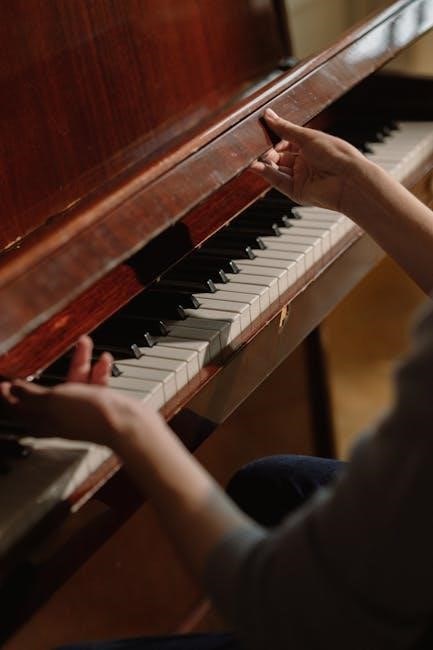
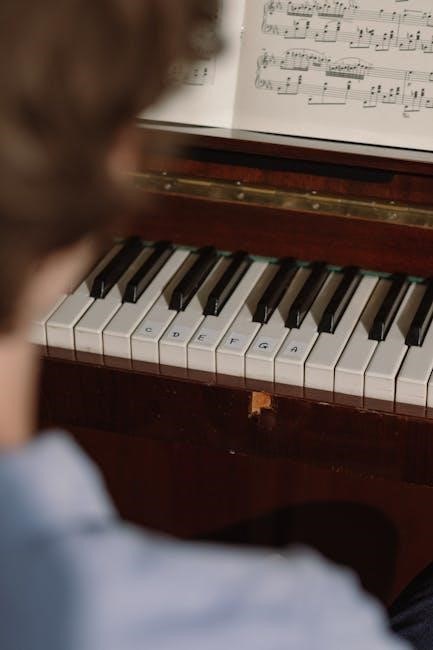
PianoLessons4Children;com provides specifically designed “Jingle Bells” piano sheets ideal for novice players. These arrangements prioritize simplicity, utilizing large notation and simplified rhythms to facilitate easy learning. The website often includes lettered notes directly on the staff, assisting children in identifying the correct keys.
Furthermore, the site’s “Jingle Bells” PDF typically features a clear layout and minimal ornamentation, focusing on the core melody. Lyrics are frequently incorporated, encouraging simultaneous singing and playing. This resource is particularly valuable for educators or parents introducing piano to young learners, offering a gentle and accessible entry point to the holiday classic.
Types of “Jingle Bells” Piano Arrangements Available as PDFs
Explore diverse Jingle Bells piano PDFs – easy beginner versions, intermediate challenges, advanced pieces, solo performances, and engaging four-hand duet arrangements are available.
Easy Piano Arrangements for Beginners
For those new to the piano, numerous simplified “Jingle Bells” PDFs exist, focusing on single-note melodies and basic chord progressions. These arrangements typically utilize only the right hand for the melody, with simple left-hand accompaniments like single bass notes or basic chords.
Websites like PianoLessons4Children.com specifically cater to beginners, offering arrangements designed for easy learning. These versions often avoid complex rhythms or hand positions, making them ideal for building foundational skills.
Look for PDFs that clearly indicate finger numbers and utilize a limited range of notes. Many free resources on 8notes.com also provide beginner-level options, often labeled as “Easy Piano.” These arrangements prioritize playability over complexity, ensuring a rewarding experience for novice pianists eager to learn a classic holiday tune.
Intermediate Level Arrangements
Intermediate “Jingle Bells” piano PDFs introduce more complex harmonies, rhythms, and hand coordination. These arrangements often incorporate broken chords, slightly more challenging left-hand patterns, and potentially some octave playing. Expect to encounter more frequent key changes and a fuller sound compared to beginner versions.
Arrangements by composers like T. Cerisier, available as free downloads, may fall into this category, offering a step up in difficulty without being overly demanding.
Resources like 8notes.com provide several intermediate options, often featuring more elaborate introductions and variations on the main melody; Players at this level should be comfortable reading both treble and bass clef and have a basic understanding of chord voicings. These PDFs aim to enhance musicality and technique.
Advanced Piano Arrangements
Advanced “Jingle Bells” piano PDFs present a significant challenge, demanding a high level of technical proficiency and musical interpretation. These arrangements frequently feature complex harmonies, intricate countermelodies, and virtuosic passages, including rapid scales, arpeggios, and ornamentation.
Expect to encounter demanding rhythms, sophisticated chord voicings, and potentially improvisational sections. While less common for a traditionally simple tune, advanced arrangements aim to transform “Jingle Bells” into a concert-level piece.
Finding these PDFs may require searching specialized sheet music websites or composer-specific resources. Arrangements by Jacob Koller, though potentially shorter, could demonstrate advanced techniques. Players should possess excellent sight-reading skills and a strong understanding of musical form to tackle these challenging pieces effectively.
Solo Piano Arrangements
Solo piano arrangements of “Jingle Bells” PDFs are the most prevalent and accessible format, catering to pianists of all skill levels. These arrangements feature the complete melody and harmony played entirely by a single pianist, without accompaniment.
You’ll find variations ranging from simplified beginner versions to more elaborate interpretations. Many free PDFs, like those available on 8notes.com and Free Music Archive, fall into this category. Arrangements by James Lord Pierpont (via trainboy647) are commonly found as solo pieces.
These PDFs often include standard notation, potentially with fingering suggestions. They are ideal for practice, performance, and developing piano technique. The focus is on the pianist’s ability to convey the song’s joyful spirit through expressive playing.
Duet Arrangements (Piano Four Hands)
Piano four-hands arrangements of “Jingle Bells” PDFs offer a collaborative musical experience, perfect for students and teachers or two pianists enjoying a duet. These arrangements divide the musical parts between two players sharing the same piano keyboard.
While less common than solo arrangements, duet versions provide a unique learning opportunity, enhancing rhythm, coordination, and ensemble skills. Searching specifically for “piano four hands Jingle Bells PDF” will yield results, though availability may be limited compared to solo options.

These PDFs typically present a clear division of notes and rhythms for each pianist, creating a fuller, richer sound than a solo performance. It’s a fantastic way to engage in musical interaction and festive fun!

Understanding Piano Sheet Music Basics
Mastering key and time signatures, note reading, rhythms, and chord decoding unlocks the “Jingle Bells” PDF, enabling confident piano playing and musical enjoyment.
Key Signatures and Time Signatures
Understanding key signatures is crucial when interpreting a “Jingle Bells” piano PDF; they indicate sharps or flats, defining the tonal center of the piece. Most arrangements are in a simple key like C major, featuring no sharps or flats, making it accessible for beginners. However, some variations might transpose to other keys.
Time signatures, typically 4/4 in “Jingle Bells” arrangements, dictate the rhythm. This means four beats per measure, with a quarter note receiving one beat. Recognizing these elements allows you to accurately interpret the sheet music’s rhythmic structure. Correctly identifying these foundational elements within the PDF ensures a musically accurate and enjoyable performance of this classic holiday tune, regardless of arrangement complexity.
Reading Notes on the Staff
Decoding notes on the piano staff within a “Jingle Bells” PDF requires familiarity with treble and bass clef notation. The treble clef generally holds the melody, while the bass clef supports the harmony. Identifying note positions – lines and spaces – corresponds to specific piano keys.
Beginners should focus on landmark notes like middle C to build a reference point. As you progress, practice recognizing intervals and patterns. “Jingle Bells” arrangements often utilize a limited range of notes, making it an excellent piece for developing sight-reading skills. Consistent practice with the PDF will enhance your ability to quickly and accurately translate notation into musical performance.
Understanding Rhythms and Note Values
Successfully playing a “Jingle Bells” piano PDF demands understanding rhythmic notation. Note values – whole, half, quarter, and eighth notes – dictate duration. A quarter note receives one beat, a half note two, and so on. Rests indicate silence, mirroring note values.
Time signatures (like 4/4 in many arrangements) define beats per measure. “Jingle Bells” often features straightforward rhythms, ideal for beginners. Pay attention to ties and dots, which extend note durations. Accurately interpreting these elements ensures a musically correct and enjoyable performance. Practice clapping rhythms separately before playing with the PDF to solidify your understanding.
Decoding Piano Chords
Mastering “Jingle Bells” piano PDFs involves recognizing common chords. Typically, arrangements utilize simple triads – major and minor – built from the key signature. Look for chord symbols (e.g., C, G7, F) above the staff, indicating which notes to play simultaneously.
Beginner PDFs often feature chords in root position, while intermediate versions may introduce inversions. Understanding chord progressions – the order in which chords appear – enhances musicality. Practice transitioning smoothly between chords. Many free PDFs don’t explicitly label chords, requiring ear training or referencing a chord dictionary. Deciphering these harmonies unlocks the song’s full potential.

Specific “Jingle Bells” PDF Arrangements to Look For
Explore arrangements by T. Cerisier, James Lord Pierpont (trainboy647), and Jacob Koller, readily available as free PDFs for diverse piano skill levels.
Arrangement by T. Cerisier
T. Cerisier’s arrangement of “Jingle Bells” is frequently encountered as a freely downloadable PDF, making it a popular choice for pianists of all levels. The document, often found alongside other sheet music collections, presents a straightforward rendition of the classic Christmas carol. It’s particularly well-suited for those beginning their piano journey, offering a relatively simple harmonic structure and easily readable notation.
Many online repositories host this version, ensuring accessibility for anyone seeking to learn or perform the tune. The arrangement typically includes standard musical notation, clearly displaying the melody, chords, and rhythmic patterns. Its simplicity doesn’t detract from the joyful spirit of the song, providing a solid foundation for developing piano skills while enjoying a beloved holiday favorite. Finding this PDF is generally quite easy through a quick online search.
Arrangement by James Lord Pierpont (trainboy647)
The “Jingle Bells” piano arrangement credited to “trainboy647” is a readily available PDF, often found on sheet music sharing platforms like 8notes.com. This version, based on the original composition by James Lord Pierpont, is specifically tailored for solo piano performance. It’s a popular download due to its clear presentation and faithful adherence to the traditional melody and harmonic structure.
While generally considered an intermediate-level arrangement, it remains accessible to motivated beginners. The PDF typically includes standard musical notation, offering a complete and playable rendition of the song. “trainboy647’s” arrangement is appreciated for its accuracy and ease of reading, making it a reliable resource for pianists looking to learn or refresh their performance of this timeless holiday classic. It’s a convenient and free option for festive musical enjoyment.
Arrangement by Jacob Koller
Jacob Koller’s “Jingle Bells” piano arrangement, available as a PDF, presents a concise and accessible take on the holiday standard. Often found as a short document spanning approximately five pages or sections, it provides a complete musical score for the song. This arrangement appears to cater to a range of skill levels, though it’s generally considered suitable for beginner to intermediate pianists.
The PDF format allows for easy download, printing, and viewing on various devices. Koller’s arrangement focuses on delivering a clear and playable rendition of “Jingle Bells,” making it a valuable resource for those seeking a straightforward and readily available sheet music option. It’s a practical choice for quick learning and festive performances, offering a compact yet complete musical experience.

Printing and Using Your “Jingle Bells” Piano PDF
Ensure optimal print settings and quality paper for clear sheet music; alternatively, utilize tablets or e-readers for convenient, portable practice sessions!
Optimal Printing Settings
Achieving a high-quality print of your “Jingle Bells” piano PDF is crucial for a pleasant playing experience. When printing, select “Fit to Page” to ensure all musical notations are visible without cropping. A resolution of at least 300 DPI (dots per inch) is recommended for sharp, clear notes and symbols.
For best results, choose a paper size of 8.5 x 11 inches (standard letter size). Disable any background images or colors in your printer settings to conserve ink and enhance readability. Preview the print before finalizing to confirm proper scaling and layout. Consider using grayscale printing if color isn’t essential, further reducing ink consumption. Experiment with different printer settings to find what works best for your specific printer model and paper type.
Paper Quality Recommendations
Selecting the right paper significantly impacts the longevity and usability of your printed “Jingle Bells” piano PDF. Standard 20lb printer paper is suitable for casual use, but for frequent practice or performance, a heavier weight paper – around 24lb or 28lb – is preferable. This resists tearing and provides a more substantial feel.
Bright white paper enhances readability, making the notes and symbols stand out. Consider acid-free paper to prevent yellowing and deterioration over time, preserving your sheet music for years; Matte paper reduces glare, which is especially helpful under stage lighting or bright room illumination. Avoid glossy paper, as it can cause reflections and make reading difficult. Archival-quality paper offers the best protection and durability.
Using a Tablet or E-Reader for Viewing
Viewing your “Jingle Bells” piano PDF on a tablet or e-reader offers portability and convenience. Utilize apps designed for sheet music display, like ForScore or Sheet Music Pro, which allow for annotation, page turning, and organization. Ensure sufficient screen brightness for comfortable reading, and consider a matte screen protector to minimize glare.
Zoom functionality is crucial for detailed viewing, especially for complex passages. Many apps support Bluetooth page-turning pedals, enabling hands-free operation during practice. Organize your PDFs into playlists for easy access during performances. Back up your digital sheet music to the cloud to prevent data loss. A larger screen size enhances readability, making it easier to follow the music.
Tips for Practicing with the Sheet Music
Effective practice with your “Jingle Bells” piano PDF begins with slow, deliberate playing. Focus on accuracy before speed, and isolate challenging sections for focused repetition. Utilize a metronome to develop consistent timing and rhythm. Annotate the sheet music with fingerings, dynamics, and phrasing markings to aid memorization and interpretation.
Break down the piece into smaller phrases, mastering each before combining them. Listen to recordings of “Jingle Bells” to internalize the melody and style. Practice hands separately before combining them, ensuring coordination. Regularly review previously learned sections to reinforce retention. Consistent, focused practice yields the best results!

Copyright and Usage Rights of “Jingle Bells” PDFs
Fortunately, “Jingle Bells” is in the public domain, allowing free use of many PDF arrangements for personal enjoyment and non-commercial educational purposes.
Public Domain Status
The delightful news for pianists is that “Jingle Bells,” composed by James Lord Pierpont, is firmly established within the public domain. This crucial status means the original composition is no longer protected by copyright, granting extensive freedoms regarding its use; Consequently, numerous piano arrangements, particularly those based directly on Pierpont’s melody, are freely available as PDFs without requiring permission or licensing fees.
This public domain standing explains the abundance of free sheet music options found across websites like 8notes.com and PianoLessons4Children.com. Individuals can download, print, and perform these arrangements for personal enjoyment, educational purposes, or even public performances without legal concerns. However, it’s important to note that specific arrangements created by modern composers might still be under copyright, even if they utilize the public domain melody.
Non-Copyrighted Arrangements
Beyond the original composition’s public domain status, many specific “Jingle Bells” piano arrangements are also explicitly offered as non-copyrighted. This often applies to simplified or traditional arrangements intended for beginner pianists or educational use, readily found on platforms like Free Music Archive and PianoLessons4Children.com. These arrangements are frequently shared with a permissive license, encouraging widespread distribution and performance;
However, verifying the non-copyrighted status is always prudent. While many sources state “non-copyrighted,” it’s wise to check for any accompanying usage terms or disclaimers. Arrangements by composers like T. Cerisier, when offered freely online, often fall into this category, allowing for unrestricted use. Remember, the absence of a copyright notice doesn’t automatically guarantee freedom; diligent checking ensures legal compliance.
Permitted Uses of Free Sheet Music PDFs
Generally, free “Jingle Bells” piano PDF sheet music, particularly those in the public domain or explicitly labeled as non-copyrighted, allows for broad personal use. This includes downloading, printing for personal practice, and performing the arrangement for non-commercial purposes – think home enjoyment, school recitals, or charitable events.
However, redistribution or selling of the PDFs is typically prohibited without explicit permission from the copyright holder (if any). Using the arrangements for commercial gain, such as in paid performances or instructional materials, usually requires securing appropriate licensing. Always respect the terms of use specified by the source website, like 8notes.com, to ensure ethical and legal compliance when enjoying these festive arrangements.